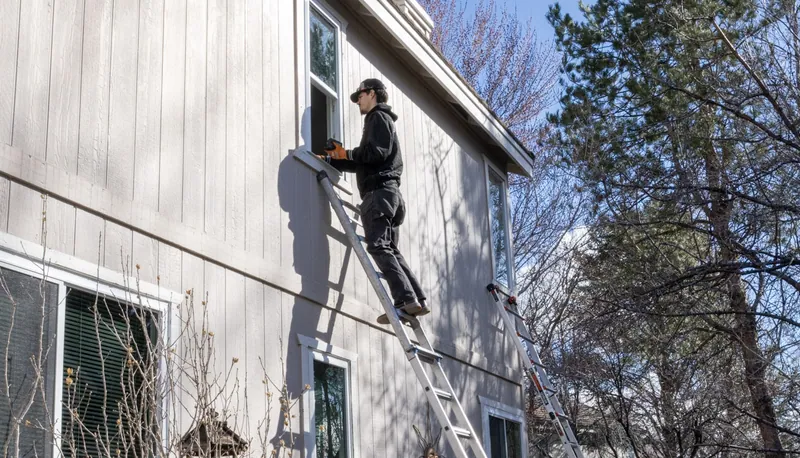
Cooling-season heat gain is an orientation problem before it is a product problem. A window that is right on a shaded north wall is the wrong specification on a west elevation of the same house, and the figure that decides the difference is not the one most quotes lead with.
Two label lines, and which one is working in July
Every certified unit carries a rating label, and the two headline numbers on it answer different questions. U-factor describes how fast heat conducts through the assembly in either direction; it is the number that governs a cold January night. Solar heat gain coefficient describes the fraction of the sun’s energy that gets through the glazing and ends up in the room; it is the number that governs an August afternoon.
A cooling problem is a solar heat gain problem. Lower means less transmitted solar energy. Two further lines matter and routinely get skipped: visible transmittance, which is how much daylight comes through, and air leakage, which is the rate measured for that unit as tested.
All four are on the certified label for the exact unit and configuration being bought. A brochure gives ranges across a product family; a label gives the number for the thing going in your wall. We read the label, and we hand it over with the estimate.
Orientation sets the target, not the house
South
In summer the sun is high. A south window can be shaded by geometry (an overhang, a deep head trim, a balcony above), and the same high angle that makes shading straightforward in July is what lets the low winter sun in under that overhang in January. Which is the argument for not driving south solar heat gain to the floor on a house that has real overhangs.
West, and to a lesser extent east
Late-afternoon sun is low and arrives close to horizontal, so no overhang of a sensible depth shades it. West is also the hottest hour of the day, which means the two loads coincide. This is the elevation where the lowest solar heat gain coefficient in the package belongs, and where exterior shading repays itself fastest if the glass area is large.
North
Very little direct gain. Spend the budget here on visible transmittance and keep the daylight, because a low-gain package on a north wall costs light and buys back close to nothing.
The house does not have one answer. It has an answer per wall, while the frame, colour, hardware and profile stay common so the building still reads as one job rather than four.
Keeping the daylight: the ratio to ask about
Visible transmittance divided by solar heat gain coefficient is the light-to-solar-gain ratio. A higher ratio means more daylight per unit of solar heat, and it is exactly what a spectrally selective low-emissivity coating is engineered to deliver: pass the visible light, reflect a large share of the near-infrared that was not doing anything useful for you.
Ask which surface the coating is on. In a double-glazed unit the surfaces are numbered from the outside in. A coating on the second surface (the inboard face of the outer lite, or pane of glass) is the cooling-oriented position. A coating on the third surface is the high-solar-gain, heating-oriented position. Same product family, different behaviour, and any supplier can answer it in one sentence.
Tint is a different lever and a weaker one. A tinted lite absorbs energy and re-radiates part of it inward, and it costs visible light to do it. Spectrally selective coatings are the reason tint stopped being the default answer.
The frame is part of the same problem
Glass gets the attention, and on a hot west wall the frame is doing something too. A dark frame on a sunlit elevation runs well above air temperature, and what happens to that heat depends on what the frame is made of. Aluminium conducts it straight through unless the extrusion carries a genuine thermal break, which is why an untreated aluminium frame will show condensation on the metal before the glass ever fogs in winter, and why it contributes on the other side of the year as well.
Vinyl and fiberglass conduct far less, and they behave differently as they heat: vinyl moves more with temperature than fiberglass does, which is why a large dark vinyl frame on a west wall is a specification worth thinking about rather than a colour choice. Whatever the material, the U-factor on the certified label is for the whole assembly (frame, spacer and glass together), so a good glass package in a poor frame shows up in that one number and nowhere else on the sales sheet.
Shading works better outside the glass than inside
Once solar energy is through the glazing it is in the room. Interior blinds and drapes then re-radiate part of it back into the space. They are genuinely useful for glare and for radiant comfort beside a large window, and they are weak as heat-gain control.
Anything that intercepts the energy before the glass is a different order of effective: an overhang on a south wall, an exterior solar screen or roller shade, an awning, a deep reveal, or planting that shades a west wall through the afternoon. On a west elevation carrying a lot of glass, exterior shading and a low-gain package together are worth more than either alone.
Retrofit film: two things to settle first
Applied film is a real option and it has two failure modes worth knowing before a deposit changes hands.
The first is thermal stress. An absorbing film raises the temperature of the glass it is stuck to, and annealed glass has less thermal-stress capacity than heat-treated glass. Film manufacturers publish which films may go on which glass types and in which orientations. That is the document to ask for, by name.
The second is the warranty. Sealed-unit warranties commonly exclude, or void on, applied films, because a film changes the thermal regime the edge seal was designed around. Read the glass warranty and the film warranty together, and get the answer in writing before anything is applied to anything.
There is also a physics reason an exterior shade beats an interior film for the same money on a hard west wall: film on the interior surface means the energy is being absorbed inside the building envelope rather than outside it.
The wall is a heat-gain path too
Cladding on a sunlit elevation runs well above air temperature, and the darker it is the further above. What separates a hot surface from a hot room is what sits behind that cladding: a ventilated cavity, a continuous layer of insulation, and an air barrier that is genuinely continuous rather than mostly continuous.
This is where a re-side earns its comfort improvement, and it is why we look at the wall and the windows on the same visit. Replacing glass on a wall with no cavity insulation improves one path and leaves the other exactly as it was.
The summer walk-round, item by item
Before anything gets quoted, this is what we check on the existing assembly. Most of it costs nothing but time to look at.
- Weep openings at the sill: clear, and not painted or sealed shut
- Sash locks engaged. A lock is not only security: it pulls the sash into the weatherstrip and is a large part of the unit’s air seal
- Weatherstrip compression set, torn or missing at the corners
- Haze, streaking or a visible film between the panes, which is a failed edge seal and not repairable in place
- Sealant beads at head flashing, trim bands and siding butt joints, checked for adhesion loss rather than for appearance
- Kickout flashing where a roof edge meets a wall
- Sill pan drainage on units that have one, and staining below the sill on units that do not
- Screen fit and track condition, because a window that will not stay open does not get used on a cool evening
- Balances, rollers and hardware, for the same reason
- End gaps at vinyl panel runs, and any panel that has bowed since it was hung
- Rust bleed under fastener heads, which is a fastener-class finding and a signal about the rest of the install
None of that is a product decision. All of it changes what the product has to do.
When the fix is a unit, and when it is the installation
The air-leakage figure on a certified label is measured on a unit in a laboratory test buck. It tells you about the window. It tells you nothing whatever about the joint between that window and your wall, and that joint is a separate scope: shim spaces filled with a low-expansion foam rather than packed with fibre, a backer rod and sealant joint at the exterior, an air seal at the interior perimeter, and flashing that sheds water at the head and the sill.
Which is why the insert-versus-full-frame question is a moisture question as much as a fit question. An insert keeps the existing frame and trim; it is faster, and it leaves the existing pan, flashing and sheathing exactly where they are and entirely unseen. A full-frame replacement takes the frame out, exposes the opening and lets the pan and the flashing be built new. Where a wall has been leaking, only the second one fixes anything.
Ask for the scope in writing either way: which one is being priced, what happens at the sill, and what the exterior joint is being closed with. Those three answers separate two quotes far more reliably than the brand on the sticker does.