Dayton · Lyon County

Dayton, Nevada: wind-corridor exposure and the siding and window specs that survive it

Dayton sits on the Carson River valley floor at roughly 4,400 feet, in unincorporated Lyon County. Wind funnels up the river canyon in the afternoon, dust comes off the Carson Plains, and the overnight drop works a glazing seal every day of the year. That narrows the product list before anyone opens a colour chart.

  • Wind-loaded elevations
  • Blowing dust
  • Wide daily swing
  • High UV
  • Old Town and Dayton Valley stock
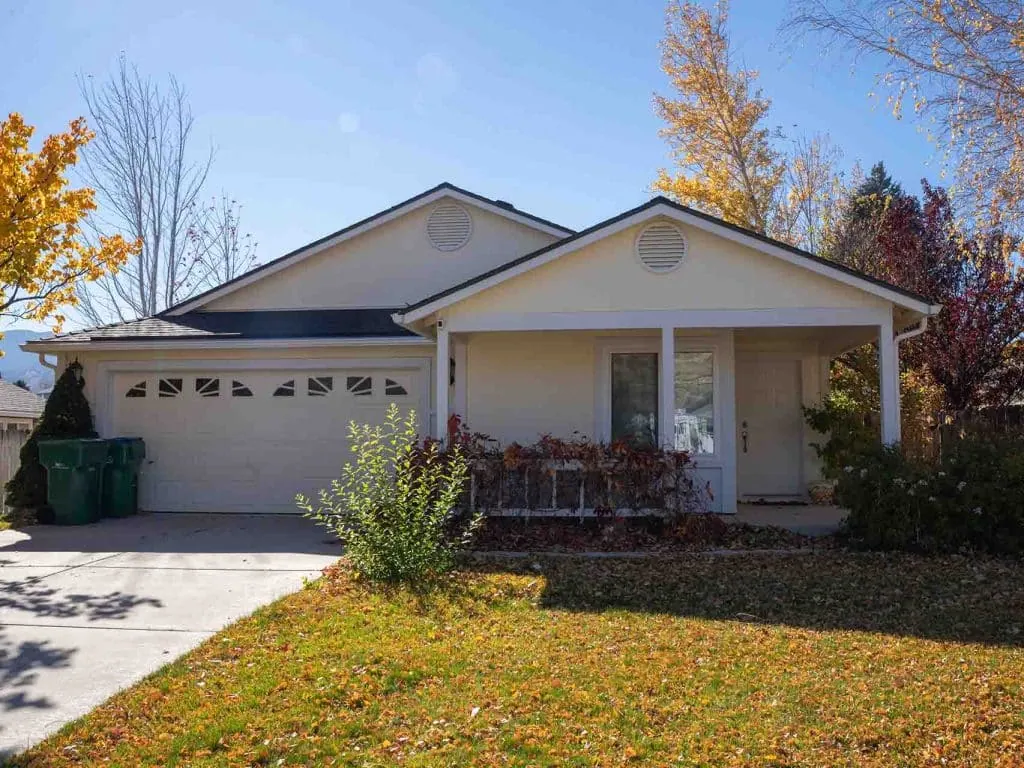
Single-storey stucco tract house with cream gable ends, round gable vents, a covered porch and an attached two-car garage, photographed in autumn
Elevation ≈ 4,400 ft, Carson River valley floor
Jurisdiction Unincorporated Lyon County
Governing loads Canyon wind · blowing dust · daily swing
Shop 1155 Watson Way, Suite 7, Sparks, Nevada

What the wall is up against

Canyon wind, Carson Plains dust and a hard overnight drop: the three loads that set the spec here

Start with the daily swing, because it does the quietest damage. A gap of 35 to 40 degrees between the afternoon high and the overnight low is ordinary on this valley floor for most of the year, and an insulated glass unit does not care whether a cycle is seasonal or daily: the gas fill expands, the sealant flexes, and the assembly ages on a 24-hour clock. Cold-air drainage down the Carson River valley makes the overnight end of that swing steeper here than on the Truckee Meadows floor, so a fogged unit in Dayton is fatigue rather than frost.

Then dust. Wind off the Carson Plains and the old mill ground carries fine material that behaves nothing like rain: it packs the weep channels along the bottom of a window frame and abrades the pile in a slider track. A weep path full of packed fines is not a drainage path, so water that should have left at the sill finds the next opening down.

Third is the wind itself, funnelled up the river canyon and arriving in the afternoon, not with a storm front. Wind-driven moisture gets pushed at a wall instead of running down it, which is why unflashed penetrations fail before the field of the siding does. Over all three sits the ultraviolet load of thin, dry air. That is what chalks low-grade vinyl and pulls a dark finish out of a west wall early.

  • Seal failure here is fatigue: count cycles, not winters
  • Weep channels and slider tracks are maintenance items in a dust corridor
  • Flashing at heads, sills and the roof-to-wall kickout carries the water

Two housing stocks

Old Town Dayton and Dayton Valley are two different jobs

Dayton is one of the oldest continuously settled places in Nevada, and the buildings say so. Old Town carries 1860s to 1900s mining-era fabric with later infill around it: irregular walls, openings rarely square, and whatever the last several owners left behind the cladding. We open a small area first, look at the sheathing and the framing at the sill, and price the repair as a line item.

The volume of Dayton's housing is newer and far more predictable: the subdivisions built through Dayton Valley from the mid-1990s to 2008, in builder-grade vinyl, stucco and hardboard trim. Those elevations are square, the openings run to standard sizes, and the failures are consistent: chalked vinyl on the west wall, hardboard fascia opening at the edges, and original double-pane units at the end of their seal life.

So the first question on a Dayton estimate is which of those two houses we are standing in front of. They need different prep and different money.

A bearded Windows and Siding Reno installer in sunglasses and a logo tee stands in front of a white work truck
What we find on each of the two Dayton stocks, and what it changes about the scope
Stock What is on the wall What fails first What goes in the scope
Old Town, 1860s to 1900s with infill Mixed cladding over irregular framing; openings out of square Sill framing and sheathing behind the trim; racked openings Exploratory opening, substrate repair priced as a line, sized-to-opening units
Dayton Valley, mid-1990s to 2008 Builder-grade vinyl, stucco fields, hardboard trim and fascia West-wall chalking, hardboard edge swelling, original IGU seals Heavier panel and finish package on the sun side, trim in a stable material

The product list

The material list for a high-wind, high-dust elevation

Exposure decides the material; the elevation decides where it goes. These are the four lines we price most often here.

Vinyl

The cheapest full re-side, and what most Dayton Valley homes already wear. On the sun side the question is panel thickness and finish package, not colour name.

Line
Alside
Strength
Cost, speed, no repaint cycle
Trade-off
Thin panels chalk and rattle

Fiber cement

Takes radiant heat without moving and holds paint longest, which is why it goes on south and west walls first. It is heavy, it needs dust control on site, and it costs the most in labour.

Line
James Hardie
Strength
Dimensional stability under heat
Trade-off
Weight, cut dust, crew size

Engineered wood

The middle option, and what usually replaces failed hardboard trim. Longer boards mean fewer butt seams, which matters when wind drives water at the joints.

Line
LP SmartSide
Strength
Fewer seams, lighter than fiber cement
Trade-off
Painted finish means a repaint cycle

Windows and doors

Casements seal tightest on a wind-facing wall; sliders cost less but ask more of the track in a dust corridor. Door hardware is specified for grit.

Lines
Andersen · Jeld-Wen · Codel
Read from
The certified label for the exact unit
Watch
Weep paths, track pile, sweeps

If the scope is settled, two deeper Dayton pages go further into each side of the job: Dayton glazing and cladding out here.

Working out here

The county line, the freight window and the measure visit

Dayton is unincorporated Lyon County, not Washoe, so the counter that reviews the work is not the one a homeowner who moved out from Sparks is carrying in their head. Lyon County's published exemption examples cover small sheds, low decks and short fences, and they do not name windows or doors. We confirm the path before we order anything.

Material comes out of the Sparks shop, which changes one practical thing: nothing comes off a wall until the units are in. The manufacturer's freight window is written into the scope, and if a colour or an odd size will stretch it, that is a conversation at the estimate rather than a phone call in week three.

On site, a dust corridor sets the day's rules. Openings that come out are closed the same day, cut stations are placed out of the wind, and the barrier and flashing go on before anyone hangs a panel.

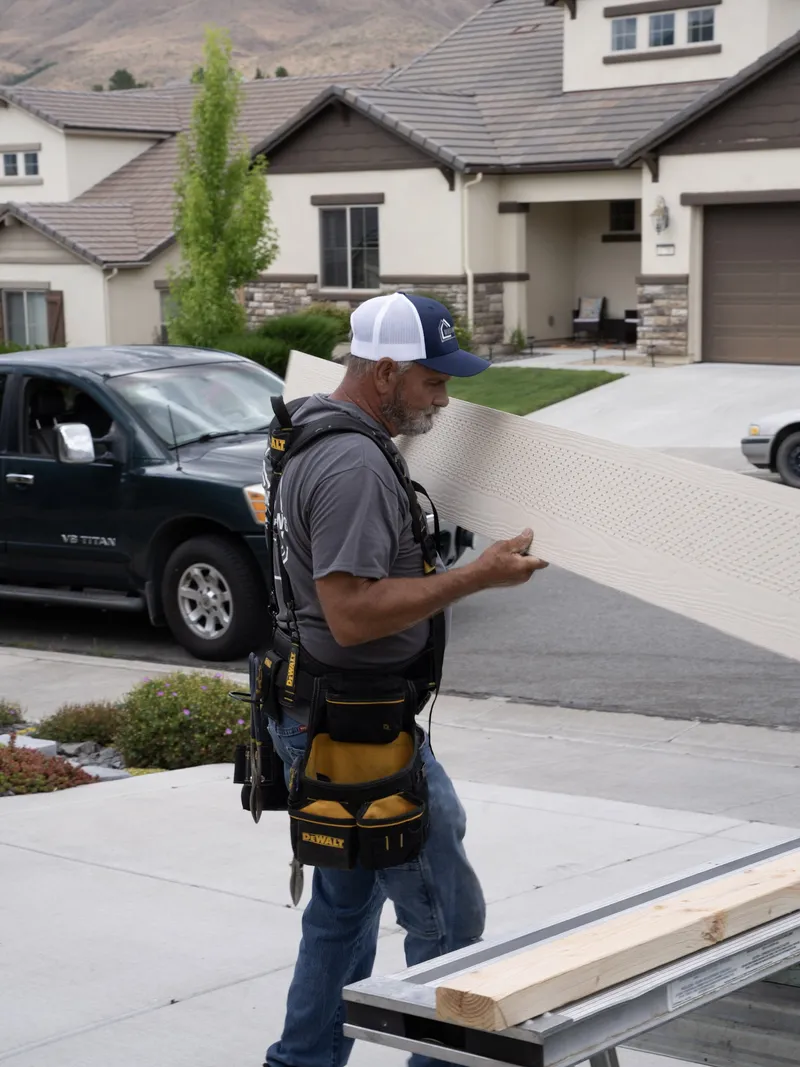
Crew member in a harness carrying a vented soffit plank across a driveway
A vented soffit plank on its way to the eave. Vent area is sized to the attic it serves, and cutting happens at a station set out of the wind.

Before you buy

Product questions we get on Dayton estimates

Next step

Tell us which Dayton house it is and we will come measure it

Old Town or Dayton Valley, the visit is the same shape: every opening measured, the substrate checked where we can see it, and a written scope carrying the product line, the profile or glass package, and the manufacturer's rating documents. The freight window for the order is written into that scope as well.

Prefer to talk? The shop line is (775) 391-8487, Monday to Friday, 9:00 AM to 4:00 PM.

  • Nothing is priced off a photo: we bring a tape to Dayton
  • Substrate repair is a priced line, not a surprise

Request a free estimate

Fields marked * are required.

It tells us which kind of measure visit to plan for.