Installation detailing
Seven window failures we see weekly, and which ones are warranty claims
Almost every service call reduces to one of seven symptoms. Four of them sit in the window, three sit in the wall around it, and that difference is what decides whether the claim goes to a manufacturer, to the installer who set the unit, or to nobody at all.
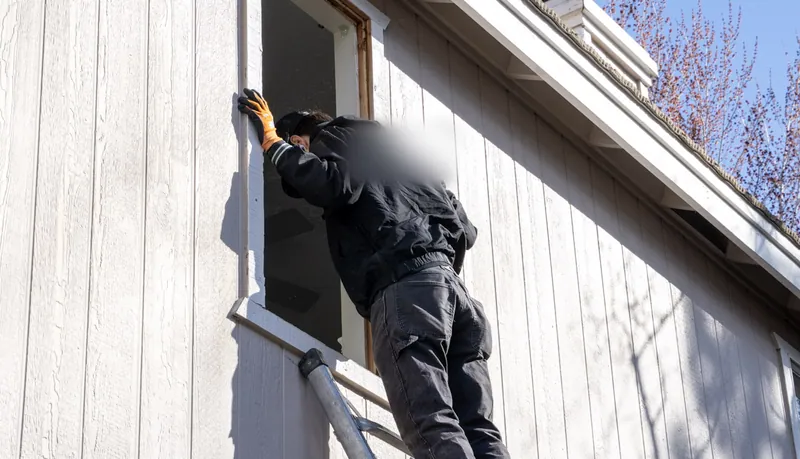
We log every service call by symptom, and past a certain number the list stops growing. Seven descriptions cover nearly everything anyone calls us about. The list is not the useful part. Each symptom points at a different place in the assembly: the sealed glass unit, the sash hardware, the frame's drainage path, or the joint between the frame and the rough opening. Those four do not have the same owner, which is why the diagnosis decides the paperwork.
1. Fog between the panes, which is the sealed unit letting go
An insulated glass unit is two or three lites (panes of glass) sealed to a spacer, and the spacer carries the desiccant that keeps the cavity dry. When the seal degrades, damp air works in, the desiccant reaches capacity, and moisture condenses where no cloth can reach it. By then any gas fill is long gone, and a low-E coating wetted repeatedly can etch, so a haze often stays after the moisture dries off on a hot afternoon. The check takes ten seconds: wipe both faces, and if the haze is on neither, it is between them. We then photograph the identifier rolled into the spacer or etched at a corner of the lite, because that ties the unit back to a production run.
2. A sash that will not stay up, or drags on the way
On a double hung this is the balance, in one of two families: a spiral balance, a twisted rod in a tube tensioned by the hook at the bottom, or a block-and-tackle balance, a spring, cord and pulley riding in a shoe in the jamb channel. Both are matched to the weight of the sash they carry, so a balance bought on size alone is a return visit waiting to happen. We pull the sash and read the stamp in the channel before ordering. Hardware terms tend to be shorter than glass terms, so on an older line this is a parts-availability question first.
3. Water standing in the sill track, which means the weep path is blocked
Every modern window assumes some water gets into the frame. The sill chamber collects it and pushes it back outside through weep slots, normally behind a small hinged flap on the exterior face. A blocked weep does not leak at the weep. It fills the chamber and spills over the interior sill dam, so by the time a stain appears the water has been standing a while. Test it with a cup of water poured into the track while somebody watches the outside. The usual culprits are sealant run across the bottom of the frame by somebody being helpful, packed dust and insects, or paint from an earlier trade. None of that is a manufacturing defect.
4. Draught at the perimeter rather than through the window
These get confused constantly. The air leakage figure on a certified rating label describes the unit as tested in a laboratory and says nothing about the shim space between the frame and the rough opening. To separate them, run a smoke pencil along the frame-to-trim line rather than the sash line; if the smoke moves at the trim, the opening is talking. The fix is not a second bead of caulk over the first. It means pulling the interior stop, filling the shim space with low-expansion foam or with backer rod and sealant sized to the gap, and rebuilding the exterior joint. Over-foaming bows the jamb and binds the sash.
5. A curved crack with no point of impact, which is thermal stress
A stress crack leaves the edge of the lite at right angles and then curves away. There is no chip, no star, no place where something struck it. The cause is a temperature difference across a single lite (the edge shaded and cool under the frame while the middle takes full sun), and anything that widens that difference raises the risk: solar film applied to an insulated unit, a dark blind hung tight to the glass, snow banked against the bottom of one lite. Glass coverage commonly excludes breakage, and applied films are commonly listed as ending it, so read that clause before anybody sticks anything to your glass.
6. The lock will not throw, or the sash rattles once it is locked
A cam lock on a double hung does not merely hold the sashes shut, it pulls them together at the meeting rail and compresses the weatherstrip. Let the keeper drift a sixteenth and the cam rides over it rather than under it, so the lock closes and the sash still moves. Confirm the sash is square in the opening, then adjust the keeper. Moving the keeper to chase a sag hides it for a season and makes the eventual repair larger.
7. Staining below the sill corners, which is the wall rather than the window
This is the one that gets misread most often. Water arriving inside below the sill corners, or drywall gone soft under the window, is usually flashing: no sill pan, or a pan with no back dam; a barrier lapped under the head flashing instead of over it; a roof dying into a wall above with no kickout to throw the runoff clear. Water travels before it shows, so the stain is rarely under the entry point. We hose-test one zone at a time, in a fixed sequence: sill, jambs, head, then the wall above.
Which of the seven a document usually answers
| Symptom | Where the defect actually is | Whose document |
|---|---|---|
| Fog between panes | Sealed unit seal and desiccant | Manufacturer, most often |
| Sash will not hold | Balance, shoe or operator | Manufacturer, on the shorter hardware term |
| Water in the sill track | Weep slots and baffles | Nobody; it is maintenance |
| Draught at the trim | Shim space, not the unit | Whoever installed it |
| Curved crack, no impact | Thermal stress in one lite | Usually nobody; breakage is commonly excluded |
| Loose or stiff lock | Keeper alignment, or a sagging sash | Manufacturer, if the part itself failed |
| Stain below the sill | Pan, flashing or barrier laps | Whoever built the wall detail |
The word doing the work there is typical. Terms run from different start dates on different lines, several separate the glass term from the hardware term from the finish term, and transfer to a second owner is often limited. We read your document rather than telling you what it probably says.
What we bring to a claim visit
A claim that gets paid is a claim that arrives complete: the order the units came on, a photograph of the spacer code, the rating label if it is still on the glass, dated photographs from inside and outside, and an elevation and opening number so nobody argues later about which window. We also count how many units show the same thing. A pattern across one elevation reads very differently to a single unit. Where the answer is replacement, see replacement windows and the Reno page.
From the service log
What owners ask once the failure has a name
Often, yes. Where the line uses removable glazing beads, the sealed unit comes out of the sash and a new one is built to the measured sight size and glass make-up, leaving frame, trim and exterior alone. Some fixed picture units are glazed into the sash at the factory and take a sash or a whole unit instead. We lift one bead before quoting, because the two answers are nowhere near each other.
The order the unit came on, the identifier stamped into the spacer or etched at a corner of the lite, and dated photographs of the fogging. That stamp is what matches your window to a production run, so we shoot it before anything comes apart. What the coverage then pays for is set out in the document that came with the order, and it differs by line.
Usually not, because most glass coverage excludes breakage outright, and aftermarket films applied to an insulated unit are commonly listed as ending it. The argument runs the other way when the crack originates at a fabrication blemish on the edge of the lite, which is why we photograph the origin before the sash is moved.