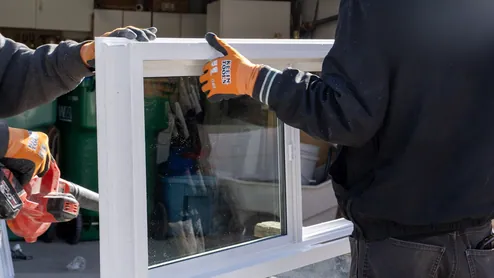
What an insulating glass unit is, and what actually fails
An insulating glass unit is two or three lites (panes of glass) held apart by a perimeter spacer. Inside that spacer is a desiccant absorbing the small amount of moisture sealed in at the factory. Around the outside are two seals: a primary seal keeping gas in and vapour out, and a secondary seal holding the sandwich together structurally.
When that perimeter seal loses (ultraviolet on the edge, water standing in the glazing pocket, thousands of cycles of a cavity expanding on a hot afternoon and contracting overnight), outside air begins moving in and out, and it brings moisture. The desiccant absorbs it until it is saturated, and the first cold night after that you get condensation on the inside faces of the glass. That is the fogging: not dirt, not cleanable, and not a symptom of the frame. The useful consequence is that the failed part is often the cheapest part of the window to replace, and it comes out without touching the opening, the trim or the siding.
Three checks that decide swap or full frame
1 · Is the sash sound, and does the hardware still exist
The unit goes back into whatever is already there, so whatever is already there has to be worth keeping: a sash that still holds square, a frame that is not bowed, weatherstrip with memory left, and balances, rollers, locks and keepers that either work or can still be bought. Hardware is the quiet deal-breaker: on a line long out of production, a good sash with a balance nobody makes any more is a window on borrowed time, and new glass in it is money spent on the wrong part.
2 · Is the failure in the glass, or at the perimeter
Fog between the lites is a glass problem. Water on the stool, staining below the sill, soft wood at the sub-sill or a draught along the meeting rail are not. Those are flashing problems, and new glass fixes none of them. A sealed unit set into a wall that is already wet only makes the view clearer while the wall keeps going.
3 · Does the frame still drain
Every modern window is built to let water in and then let it back out, and the weep openings at the sill are that path. Blocked weeps, a sill with no slope left, or a glazing pocket holding standing water will kill the next unit the way they killed the last one, and the manufacturer will point at that when the claim goes in.
How the unit gets measured and ordered
Nothing is scaled off a photo. The old unit comes out and what gets recorded is the glass size, the overall thickness, the spacer type and depth, whether the lites are annealed, tempered or laminated, whether there is a coating and which surface carries it, and any grille, obscure or tint. The etched marking in the corner says whether the glass was safety glazing. If it was, it has to be again. Then there is the bite, the glass edge sitting inside the sash: order to the daylight opening instead of the glass size and the unit will not stay in.
What a glass-only swap does, and does not, buy you
It buys back the view, the thermal performance of that piece of glass and, with a low-emissivity coating specified, better control of solar heat than an old clear unit had. It does not buy a new window. A certified rating describes the whole assembly (glass, spacer, sash and frame together), so a new unit dropped into an old aluminium frame with no thermal break does not earn the number off a new window's label. The frame is still the bridge, and condensation still shows up on the metal first.
Warranty, and the sentence to read first
Sealed units carry the manufacturer's own warranty, with its own period, transfer terms and list of what voids it. Two clauses matter here: many are void if the unit is replaced by someone the manufacturer has not authorised, and most are void if the glazing pocket is not drained. Read whose name is on the document before deciding who does the work. We hand that paperwork over rather than summarising it.
When full frame is the only honest answer
- Rot or crushing at the sill, sub-sill or lower jambs
- An opening out of square, so the sash no longer seals along its length
- Obsolete hardware with no parts path
- Single-glazed aluminium, where the frame is most of the problem
- Any wall where the cladding is coming off anyway: with the siding open the flange and flashing can be integrated properly, which is the one chance to fix the detail that fogged the last unit
That last one is worth planning around rather than discovering: see sequencing windows and siding in one project.
If the survey says replace, our page on frames, styles and glass packages sets them out in detail.