Installation detailing
Signs it is time to replace your windows and siding: the field test we run before quoting
Repair is the right answer when the failure is local, the sheathing behind it is dry, and the product can still be matched. We test all three before pricing anything, because two of the three cannot be seen from the driveway and the third is the one people guess at.
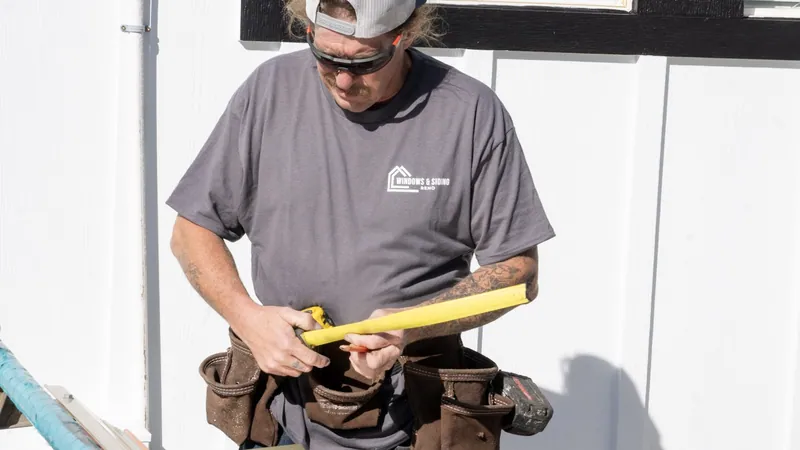
There is no list of warning signs that decides this. Every visible symptom (a split board, a fogged pane, a soft trim corner, a draught) is consistent with a cheap repair and with a full tear-off, and which one it is depends on three things you cannot see from the kerb. So before we price anything we run the same short procedure, and it answers three questions in order.
The three questions, in order
- Is the failure local, or is it on more than one elevation? Damage in one place has a cause in that place. Damage in several places has a cause in the system.
- Is the sheathing behind it dry? If it is wet, the board is not the problem and replacing the board does not solve anything.
- Can the product be matched? Profile, exposure, texture and colour. A repair that cannot be matched is a permanent visible patch, and that has to be a decision rather than a surprise.
One “no” moves a job from repair towards replacement. Two makes it a replacement. That is the whole rule, and everything below is how each question gets answered.
The four tests we run on the wall
The probe
An awl, hand pressure only, at the five places rot arrives first: the bottom course, the butt ends of boards, the base trim, the band-joist line, and the fascia behind the gutter. Sound material resists. Material that takes the point past the surface without effort has lost its fibre, and no amount of paint or coil stock changes that. This test costs nothing and it settles more arguments than every other one combined.
The moisture reading
A pin meter into the sheathing wherever a board is off or a fastener can be pulled. The absolute number is less useful than people assume, because it moves with species, temperature and the meter itself. What is useful is the comparison: the same meter, the same day, on a sheltered elevation of the same house, gives a control reading, and the difference between the suspect area and the control is the figure that means something. A wall reading close to its own control is a wall with a surface problem. A wall reading far above it has water arriving from somewhere, and that somewhere has to be found before any cladding goes back on.
The tap
Fiber cement rings. Hardboard that has delaminated, and sheathing that has been wet, thud. Run a knuckle or the handle of the awl along a course and the change in note tells you where to probe next. On vinyl the equivalent test is a flex rather than a tap: a panel that has gone brittle with age cracks instead of bending, and in cold weather that is a straightforward statement about how much service life is left.
The match
The last test happens on a phone rather than on the wall. Is the profile still made? Is the exposure the same as the current version of it? Does the texture line up? And is the colour obtainable, given that the wall has had years of high-elevation ultraviolet and the new stock has had none. On discontinued profiles the answer is often no, and then the honest options are a visible patch, a donor wall, or a full elevation.
Local defect or systemic fault
The count that matters is not how many boards are damaged. It is how many elevations, and whether the damage lines up with anything. The pattern is usually the diagnosis:
| What we see | What it usually is |
|---|---|
| A vertical stripe under a roof-to-wall junction | No kickout diverter at the end of the step flashing |
| Damage stopping a foot or so above grade | Ground clearance bridged by landscaping, bark or a raised patio |
| Damage on every elevation at the same course height | A flashing or barrier detail that was done the same wrong way all round |
| Staining that begins below a window, not above it | Sill pan missing, or the sill was sealed and the pan cannot drain |
| Fading, chalking and splitting on south and west only | Ultraviolet and thermal cycling: an ageing product, not a water fault |
| Scattered damage on all four elevations | The product is at the end of its service life |
The first four of those are repairs with a detail correction attached. The last two are re-clads. Getting that call wrong is how a wall gets patched twice in six years.
Windows: sealed unit, insert or full-frame
The same triage runs on a window, with three scopes instead of two.
- The sealed unit only. Fog between the panes is a perimeter seal failure in the insulating glass unit. Sound sash, square frame, unit still in production: the glass gets changed and the window stays. It is a real repair and it is under-offered.
- An insert. A new window set inside the existing frame. Faster, cheaper, less disruption to the interior trim and the exterior cladding, and it costs glass area because one frame now sits inside another. Legitimate only where the existing frame is sound, square, dry and not the source of the problem.
- Full-frame. Back to the rough opening. It is the only scope that allows the sill pan, the jamb flashing and the head flashing to be rebuilt, so it is the only scope that fixes water arriving at the window rather than passing through it.
One distinction worth making because it sends people to the wrong scope: condensation on the room side of the glass on a January morning is usually indoor humidity meeting a cold surface, not a failed window. Condensation between the panes is failure. Frost on the frame while the glass stays clear points at the frame material rather than the glazing, which is the standard finding on an unbroken aluminium frame from the 1960s, and the reason new glass in an old aluminium frame only ever solves half of it.
When repair is the right call, and we will say so
- Impact damage on a young wall where the product code is still current.
- One run below a downspout that has been discharging against the wall: fix the downspout, replace the run.
- A sound wall whose only failure is sealant, where the joints have failed adhesively.
- A window with a sound frame and a failed insulating unit.
- An eave return, a single fascia run or one corner board.
A repair that is genuinely a repair is a better outcome than a re-clad and we would rather write it. What we will not do is patch over a wet reading.
What the written triage contains
- Where each moisture reading was taken and what the control reading was.
- Which probe points were sound and which were not.
- The pattern of damage and what it points at.
- Whether the product can be matched, and honestly how well.
- The detail correction the repair depends on (kickout, pan flashing, clearance) listed as its own line rather than absorbed into a rate.
- Where both are real options, the repair and the replacement, priced next to each other.
If the triage points at the windows, our page on window replacement scopes and glass packages walks through the options.